
Kasarinlan > Volume 32 > TWSC at Forty: Multidisciplinary Research and the Challenges to the Center
TWSC at Forty: Multidisciplinary Research and the Challenges to the Center
Ricardo T. Jose
Published 2017
On 5 February 1977, Professor Francisco “Dodong” Nemenzo, Jr., then dean of the College of Arts and Sciences in the University of the Philippines (UP) Diliman, along with other concerned faculty and intellectuals, launched the Third World Studies Program as a research unit of the college. This was during the height of martial law under President Ferdinand E. Marcos in the Philippines, when there were restrictions on free speech and discussion, when dissent was stifled. The Third World Studies Program was conceptualized as, to quote its founding director, Randolf “Randy” David, “an incubator of progressive ideas and a refuge to the dwindling number of irreverent scholars, dissident intellectuals, and social activists, wherever they may come from, and whatever cause they may champion.” It was a fulcrum of active, multidisciplinary discussion.
Forty years later, the program had advanced into a full-fledged research institution, the Third World Studies Center (TWSC), duly recognized as such since 2000 by UP’s highest governing body, the Board of Regents no less. Its mission and vision are as follows: “The TWSC envisions itself as the premier social science research center of the University of the Philippines. It is committed to analyze and develop critical, alternative perspectives on Philippine, regional, and global issues grounded on academic research in the best tradition of scholarly practice. Its mission is to promote progressive scholarship and action for change by undertaking pioneering research on issues of national and international concerns; create spaces for discussion and dialogue; publish original, empirically grounded, and innovative studies; and build a network of activist-scholars and public intellectuals.
From a multidisciplinary perspective, TWSC focuses mainly on, but not limited to, the following areas of concentration: political economy and globalization, social movements, authoritarianism and democratic governance, peace and human security, culture and identity, and (new) media and technology.” This follows the original aims that led to the founding of the program in 1977, and continues on to this day. The TWSC has a fixed staff, office space, a regular operating budget, and is now a part of the College of Social Sciences and Philosophy (one of the colleges formed after the tripartite division of the old College of Arts and Sciences in 1983). It publishes a regular journal, Kasarinlan, as well as other academic publications and monographs. It holds regular fora and public lectures. It hosts research fellows and assists them in their fieldwork. For undergraduate students, it offers, in particular, internship
opportunities that allow them to tackle social issues through video documentaries. And of course, its research staff, besides giving shape to its publications (be it print, online, or multimedia), contribute their own pioneering and relevant research projects.
To commemorate the ruby anniversary of the center, TWSC decided to host a two-day international conference on 9–10 February 2017 at the Asian Center, UP Diliman that would both reflect on the center’s past as well as highlight its contributions to scholarly and intellectual work in multidisciplinary platforms. Funding for the conference came from the UP Office of the Vice President for Academic Affairs, the UP Diliman Office of the Vice Chancellor for Research and Development, and conference registration fees. Professor Alfred W. McCoy, who has had a long and productive relationship with the center, was invited as keynote speaker. Past directors were asked to share their experiences and discuss how the center grew during their respective terms. Former and current fellows were asked to contribute recent studies on a variety of topics. The response to our requests to participate in the conference was extremely positive, and the conference had two plenary sessions, four simultaneous sessions for its twelve panels, and saw the premiere of TWSC’s historical video documentary Tranvia: Ang mga Riles ng Kamaynilaan (Tranvia: The Railways of Metro Manila). It was also an occasion to pay tribute to Dodong Nemenzo, the founder of TWSC. The two days of academic sharing and discussion were both productive and provocative, and provided many approaches to a wide and diverse range of contemporary problems and issues. The papers were all new, reflecting the state of the art, cutting edge research methodology and interpretation for which the center has long prided itself. In the course of the two days of presentation and discussion, the conference served as a reunion of scholars, both established and emerging. It thus fulfilled another aim of the center, that of providing a meeting space—a forum—that encourages critical and alternative paradigms.
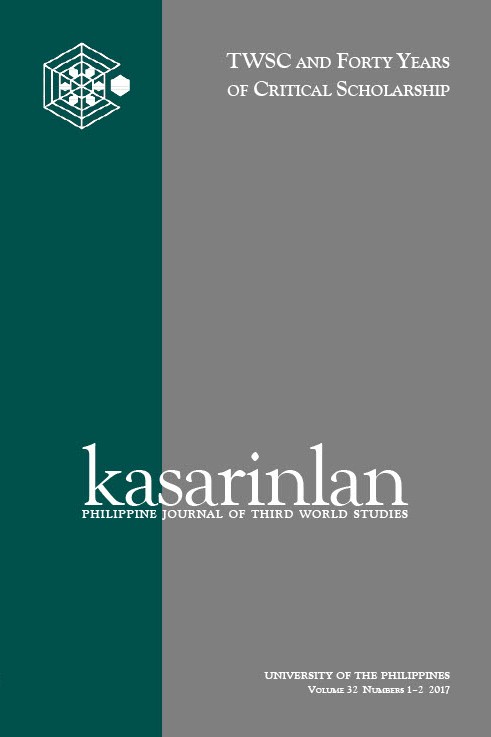
This issue of Kasarinlan provides highlights of the conference. The lead article is Professor McCoy’s keynote paper, “Global Populism: A Lineage of Filipino Strongmen from Quezon to Marcos to Duterte.” This paper looks at Philippine politics as epitomized by three presidents who wielded immense power but left a bloody trail of violence. McCoy shows that violence was very much a part of building political power since the time of President L. Quezon. The cases of political violence he cites are almost forgotten by today’s generation (if they were at all aware of them), but do illustrate how institutionalized violence by the state has long been a part of Philippine politics. Beyond simply
presenting the Philippine experience, McCoy shows how populist rule today has deeper roots and that the Duterte phenomenon is similar to other administrations in other countries. His prognostications for the Duterte administration provoked discussion and through its publication should spur further thought.
If the main backdrop in McCoy’s paper is the United State’s imperial march, the next article by Johannes Dragsbaek Schmidt (a former TWSC visiting research fellow) and Jacque Hersch, refers to the rise of its current rival in the world stage: China. Schmidt and Hersch’s “The Orient Express and Late Development,” which was also presented in the TWSC conference, provides a macro perspective of Western and Asian engagement, from the period of initial contact to the present rise of China. It is a sweeping reexamination of past interpretations of the so called Age of Exploration and early Western contact with China, characterized by Eurocentric perspectives, and presents an alternative view of the emergence of China into the global economic world from the 1970s to the present. This has important implications for interpreting present-day geopolitics and geoeconomic domination.
From prefiguring globalist tendencies, the next two articles offer a scalar shift and a study in contrast: a socialist state suffering from symptoms of capitalist malaise and a democratic one constantly challenged by a communist insurgency.
Olivier Jacques, Danielle Labbé, and Clément Musil’s paper, “Shortcomings of an Idealized Urbanity: Ghost Urban Areas and the Asynchronous Territorial Development of Hanoi,” shows how urban planning by strong governments can be flawed. In striving to modernize, the Vietnamese government’s attempt to provide new and modern urban areas to relieve congestion in older cities was subverted by profitdriven speculation and a slew of unexpected economic problems. The result: half completed or unbuilt urban centers sparsely populated because promised services never materialized. The cost to agricultural output and the agrarian sector has been significant, as formerly rich farm lands were converted to non-performing lands or fallow. Ghost towns in China are quite well known, but by closely studying the Hanoi experience, factors leading to such costly failures in Southeast Asia is pioneering research.
Joshua Eastin’s “Conflict Calamities: Natural Disasters and the CPP-NPA” provides an interesting correlation between typhoons, earthquakes, and other natural calamities and the growth of the Communist Party of the Philippines-New People’s Army (CPP-NPA) in the last decade. He explains why NPA raids on Philippine government forces increase in the wake of disasters, amidst attempts to bring in relief. His argument that the CPP-NPA takes advantage of the failure of government (due to politics) to bring in adequate and non-discriminatory aid is convincing and should be taken seriously. The use of examples from other parts of the world, particularly Latin America, indicates that the Philippine case is not unique, and that natural disasters can serve to bolster anti-government movements. The research for this paper was done partly while Eastin was a visiting research fellow at TWSC and was presented in the TWSC conference.
All these articles explore different topics and methodologies, again highlighting the multidisciplinary base of the center’s critical engagement with salient political and socioeconomic issues. And yet, despite having different foci and methodology, all papers in this issue are products of substantive empirical research. And although they focus
on the Philippines, or China and Europe, or Vietnam, the conclusions and interpretations have a wider application, and can be used as models to view other similar experiences elsewhere in the world.
The papers are followed by the presentations of TWSC’s former directors. All highlighted TWSC’s contributions to critical scholarship in the Philippines. The directors spoke of their involvement in TWSC, some of their personal memories of the center, and research agendas during their respective terms. They looked back, and in doing so fleshed out the history of the center, noting changes and continuities while they were at the helm. Discussed were prevailing conditions through the years, and how research interests and programs broadened through the years, but never distanced themselves from the center’s original aims. The former directors—Randolf S. David, Maria Serena I. Diokno, Miriam Coronel-Ferrer, Teresa S. Encarnacion Tadem, and Maria Ela L. Atienza—also looked toward the future, and how the center can further enrich the social sciences in the Philippines and beyond. These presentations can serve as the basis for a fuller history of the center, reinforce its present status, and provide directions for the
future. We also included here the proceedings of a short tribute to Dodong Nemenzo, which took place on the first evening of the conference, from which we learn his significant and enduring influence on other leaders of UP.
Two reviews and a commentary conclude this issue of Kasarinlan. The first material reviewed is the book Changing Lives in Laos: Society, Politics, and Culture in a Post-Socialist State edited by Vanina Bouté and Vatthana Pholsena. Professor Matthew Santamaria’s deft evaluation of the various scholarly works that formed the volume justifies his assessment of the book as “a most contemporary look into what has been happening to this rather under-examined nation-state at the heart of continental Southeast Asia.” Hopefully, our publication of Santamaria’s review encourages further in-depth inquiry on the country from scholars in the Philippines and the rest of the world.
The second review is of Wataru Kusaka’s Moral Problems in the Philippines: Inequality, Democracy and the Urban Poor. Wataru was a visiting research fellow of the center when he was doing the research that led to the present book. Hansley Juliano provides an in-depth review of this incisive and important contribution to present day sociopolitical analysis. Juliano has direct knowledge of what he speaks of, having been active in nongovernment organizations critical of the government. The review—and the book—nicely tie up with Professor McCoy’s keynote address and some of the other papers in this issue.
In an incisive commentary, Barbara Politsch examines six documentaries produced by TWSC, together with the University of Montreal. The joint production of short documentaries highlighting current issues in the Philippines began in 2011, and all have been shown publicly in UP and the University of Montreal. The documentaries are also all available in TWSC’s Youtube channel (https://bit.ly/2tt5XsB). Some have won awards in documentary film competitions, or have been screened in international film festivals. Filmed and edited by students from both Canada and the Philippines under the auspices of TWSC’s staff and professionals, the five documentaries reviewed tackle different aspects of Philippine socioeconomic realities. Using audiovisual methods is a novel means to convey deep-seated problems, and as the reviewer notes, has been very successful. There have been other documentaries made since 2014, continuing the new venture into alternative presentation of profound and sometimes conflicting issues.
While the topics of the papers and reviews in this issue may seem diverse on the surface, they are tied together by the basic aims of the Third World Studies Center. They deal either with understudied subjects or examine well-covered subjects in novel ways. In publishing this issue, it is hoped to further disseminate the fruits of the TWSC’s fortieth anniversary commemorative conference. In spreading these findings, arguments and conclusions, it is hoped that further discussion will be stimulated, and so too newer research into causes of today’s complex problems—and further the search for appropriate solutions to these.
Global Populism: A Lineage of Filipino Strongmen from Quezon to Marcos and Duterte
Alfred W. McCoy
Volume 32 (1-2)
The Orient Express and Late Development
Johannes Dragsbaek Schmidt and Jacques Hersh
Volume 32 (1-2)
Shortcomings of an Idealized Urbanity: Ghost Urban Areas and the Asynchronous Territorial Development of Hanoi
Olivier Jacques, Danielle Labbé, and Clément Musil
Volume 32 (1-2)
Conflict Calamities: Natural Disasters and the CPP-NPA
Joshua Eastin
Volume 32 (1-2)