
Kasarinlan > Volume 30 > The 2015 Third World Studies Center Writeshop
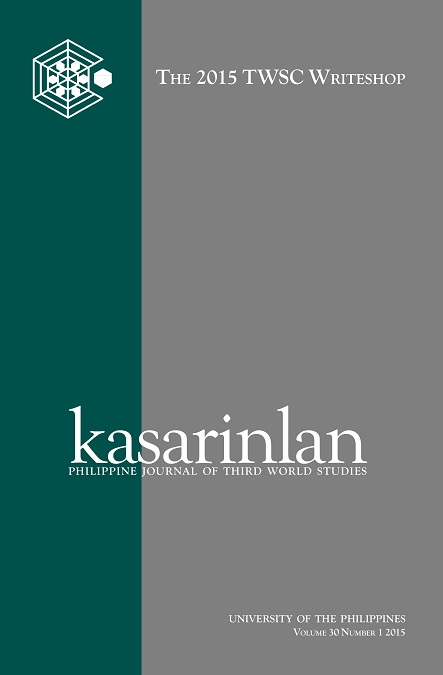
The 2015 Third World Studies Center Writeshop
RICARDO T. JOSE
On 8-10 June 2015, we conducted the annual Third World Studies Center (TWSC) Writeshop. The writeshop aims to help young faculty members, graduate students, and early-career researchers navigate the review process and get published in Kasarinlan, the Center’s internationally refereed journal. This program is part of TWSC’s goal as a multidisciplinal research center in the College of Social Sciences and Philosophy (CSSP), University of the Philippines (UP) Diliman, “to develop critical, alternative paradigms to promote progressive scholarship by undertaking pioneering research and publishing original, empirically grounded, and innovative studies.” The three-day activity was the highpoint in the eight-month long process, beginning with the call for applications, a rigorous selection process, and then the writeshop itself. The writeshop received thirty-three submissions, accepted seven, and for this issue, we have published three. The other papers may see publication in future Kasarinlan issues.
The writeshop was funded by Office of the Vice-President for Academic Affairs of the UP System, the Office of the Chancellor of UP Diliman, and CSSP, also of UP Diliman. It was endorsed by the Commission on Higher Education and the Philippine Association of State Universities and Colleges. The TWSC Writeshop is a specialized workshop that introduces the participants to the rigors of academic research and writing, and the process for getting into print after undergoing peer review. We were fortunate to have National Artist for Literature F. Sionil Jose deliver the keynote address, which set the tone for the writeshop. Five plenary lectures followed the keynote speech. Randy David (professor emeritus, Department of Sociology, CSSP, UP Diliman) gave a lecture on problematizing theory in the social sciences; Francis Gealogo (associate professor, Department of History, School of Social Sciences, Ateneo de Manila University) on the contribution of quantitative research to knowledge production in the social sciences; Raul Pertierra (professor, Department of Sociology and Anthropology, School of Social Sciences, Ateneo de Manila University) on the contribution of qualitative research to knowledge production in the social sciences; Maria Luisa Camagay (professor, Department of History, CSSP, UP Diliman) on research and publication ethics in the social sciences; and Jose Neil Garcia (UP Press director and professor, Department of English and Comparative Literature, College of Arts and Letters, UP Diliman) on the academic publication process.
The writeshop fellows’ papers were then discussed in small groups that included experts in their respective fields, with an eye to readying the drafts for publication. The experts in these small-group discussions were Maria Teresa Melgar (assistant professor, Department of Sociology, CSSP, UP Diliman), Eufracio Abaya (professor, Division of Curriculum and Instruction, College of Education, UP Diliman), Maria Ela Atienza (professor, Department of Political Science, CSSP, UP Diliman), and Augusto de Viana (associate professor, Department of History, Faculty of Arts and Letters, University of Santo Tomas). The papers were revised, and then submitted to reviewers. The papers published in this issue hurdled all the comments, criticisms, and recommendations of reviewers, as is the case with peer-reviewed academic journals: they are part of the successful outcome of the 2015 TWSC Writeshop.
National Artist Jose’s keynote speech opens this issue. Mincing no words, he paints a critical picture of Philippine scholarship and its representation of realities in the country. For some, his assertions may trigger contrary arguments, for others an affirmation of long-held beliefs. He drew freely on his own vast experience as a journalist and writer, pointing to the traditions that shape Philippine life, and the importance of history and folklore in understanding the nation and its cultures. He ends with a profound conclusion, that knowledge is not wisdom, and that scholarship is not simply the search for truth, but also justice.
Three papers from the writeshop fellows are published here.
“Tensions and Developments in Akbayan’s Alliance with the Aquino Administration,” by Hansley A. Juliano (lecturer, Department of Political Science, School of Social Sciences, Ateneo de Manila University), leads this volume. The paper deals with Akbayan, a coalition of progressive, leftist people’s organizations, its venture into national politics through the party-list system in the House of Representatives, and its decision to support the administration of President Benigno “Noynoy” Aquino III. While the Aquino administration initially offered the promise of social reform, its actual record has been disappointing. The decision of Akbayan’s leaders to support the administration thus resulted in conflicts within the party and its relations with other similar left-leaning groups. Based on a variety of primary and secondary sources, as well the author’s own experience as a one-time member of the party, this paper presents a perceptive look at the dynamics inside a leftist group which opted to work with the government through an analytical model synthesized by the author. If such an alliance were to continue without question, Juliano notes, the party would be in danger of becoming just another political party, its ability to foment reform neutralized.
“The Asia-Pacific War in the Davao Settler Zone, December 1941” by Maria Cynthia B. Barriga (MA student, History Department, School of Social Sciences, Ateneo de Manila University) presents a detailed study of the impact of war on a unique province in Mindanao. At the time the war started, Davao was a frontier which was largely populated by migrants. While many of the migrants were Filipinos from the Visayas and Luzon, Davao also had the largest community of Japanese residents in the Philippines. The outbreak of war between the US and Japan thus threatened the whole fabric of the province, bringing chaos and suspicion amongst friends and relatives. By focusing on a frontier province, this study breaks away from the more conventional accounts dealing with the Philippines’s political center, Manila. The article is a good contribution to our knowledge of World War II in the Philippines as it utilizes Japanese sources, as well as interviews with survivors. Barriga hails from Davao and studied the Japanese language, providing her with a unique perspective of the then frontier-province in a time of crisis.
“The Contested Development of Philippine Tourism Landscape: The Case of Nasugbu, Batangas,” by Hazel M. Dizon (assistant professor, Department of Geography, CSSP, UP Diliman), brings to light conflicting issues in the government’s pursuit of a tourism policy as a driver of national development. While the development of resorts in Nasugbu was meant to bring economic progress to the town, Dizon shows that its long-time residents were instead marginalized and their livelihood threatened, even as the municipal government reaped the benefits from outsiders who developed tourist sites. Based on extensive fieldwork, this study critically highlights the inconsistencies and tensions brought about by a government policy implemented without fully considering its effects, a policy that centers on income and infrastructure as it marginalizes the dispossessed and the locals in dire straits. This issue also contains reviews of books of interest to social scientists, particularly those that study social movements, and information and communications technology and society.
As National Artist Jose observed, knowledge alone and the search for truth is not sufficient, it is how knowledge is used that is wisdom. These articles provide not just new knowledge, but also new perspectives and lessons to learn from. As with all other Kasarinlan issues, we hope the articles published here encourage critical thought, alternative viewpoints, and stimulate discussion. Should readers have any comments, questions or clarifications, they are encouraged to contact the authors directly.
Tensions and Developments in Akbayan's Alliance with the Aquino Administration
Volume 30
The Asia-Pacific War in the Davao Settler Zone, December 1941
Volume 30
The Contested Development of a Philippine Tourism Landscape: The Case of Nasugbu, Batangas
Volume 30