
Kasarinlan > Volume 34 > Violence, Human Rights, and Democracy in the Philippines
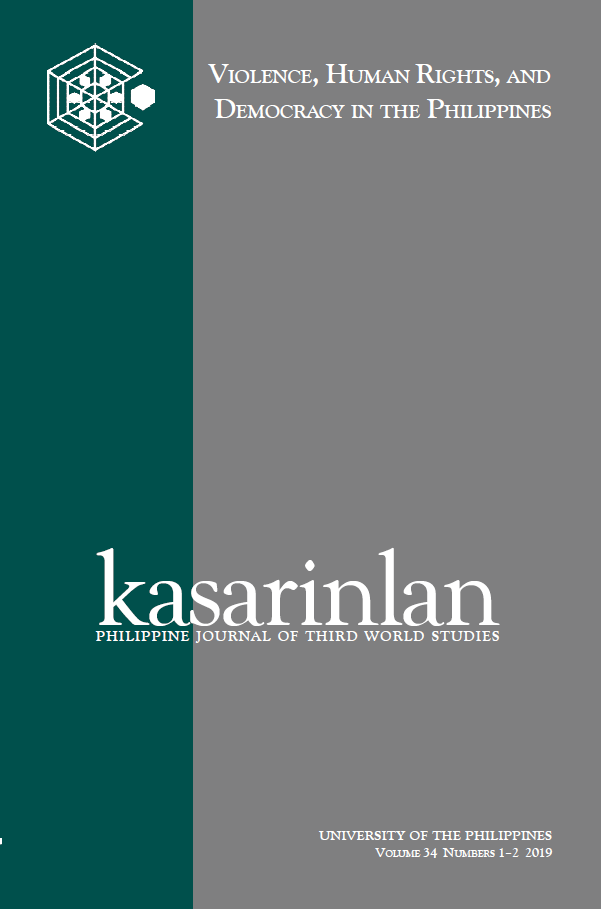
Violence, Human Rights, and Democracy in the Philippines
Jeroen Adam, Joel F. Ariate Jr., and Elinor May K. Cruz
INTRODUCTION
Violence, and the explicit call for violence as a means to achieve political ends, were key features of Rodrigo Duterte’s campaign for the presidency in 2016. When he won the office with sixteen million votes or a 39 percent plurality, it was considered as a democratic mandate to wage his so-called war on drugs. Win the war on drugs and the cures to other ills of the country will simply fall in place—that was his promise. Duterte asked for three to six months to make his vision a reality. There will be blood, he said.
This special issue of Kasarinlan: Philippine Journal of Third World Studies comes off the press with Duterte midway through his six-year term as president. There was hardly any let up to the bloodbath that he called for. The war on drugs became a war against Islamic radicals, became a war against communist partisans, became a war against conspiracies and imagined enemies, became a war that is now ravaging the very institutions that are tasked to wage it. The articles in this issue are some of the first outputs of the three-year research and advocacy collaboration between the Third World Studies Center (TWSC) of the College of Social Sciences and Philosophy, University of the Philippines (UP) Diliman and the Department of Conflict and Development Studies (DCDS), Ghent University. The complex issue of violence serves as the focal point of this joint effort. The broader background is the practice of democracy at the grassroots, on how often the mandate and the complicity for violence against a suspect class is drawn at the expense of their supposedly inalienable human rights.
Where a climate of impunity, fear, and intimidation has been introduced, the growing literature on Duterte hints at a fetishism. Against this potential analytical blindspot, our project does not make the argument that the current wave of state-induced violence in the country is pure Dutertian invention. The political opportunities that this government has seized or crafted to govern through violence are deeply-rooted in Philippine history—a history that can be described as “the narrative of the interaction of narratives,” whose cleavages play a decisive role in the production of violence (Stewart and Strathern 2002, 7). Thus, it is one of the aims of our research to render visible the contours and continuities in the deployment and experiences of violence across the country through case studies from the urban and rural brutalities of Duterte’s drug war to the imposition of martial law in Mindanao.
Through unfiltered public pronouncements, Duterte unleashed missions of extermination targeting the defenseless and the very poor, creating a disposable class whose deaths are supposed to serve as an object lesson in fear and obedience to the armed agents of the state. Duterte’s agents are supposed to be exercising the state’s monopoly on violence. What he in fact created are killers, in and out of government, that understand power as coming from the barrels of their guns. Our research traces and puts on record a violent time in human rights and democracy in the country. It tells the narratives of violence founded on the struggles against and for these classes of Filipinos.
REFERENCES
Buan, Lian. 2019. “TokHang Documents Prove Drug War Caused Cops to Kill Suspects – FLAG.” Rappler, October 23, 2019. https://www.rappler.com/nation/243230-flag-says-tokhang-documents-prove-drug-war-caused-cops-kill-suspects.
Duterte Legacy. 2019. “About.” Facebook, August 22, 2019. https://www.facebook.com/pg/DU30Legacy/about/?ref=page_internal.
Gatmaytan, Augusto B. 2019. “Martial Law, Militarization, and the Manobos of Hanayan.” Vera Files, December 17, 2019. https://www.verafiles.org/articles/
martial-law-militarization-and-manobos-han-ayan.
Gita-Carlos, Ruth Abbey. 2020. “‘Duterte Legacy’ Cites Govt’s ‘Fruitful’ Years: Andanar.” Philippine News Agency, January 17, 2020. https://www.pna.gov.ph/articles/1091159.
Mangahas, Mahar. 2020. “Human Rights in the Drug War.” Social Climate, Inquirer.net, January 18, 2020. https://opinion.inquirer.net/126696/human-rights-in-the-drug war.
Palatino, Raymond. 2020. “Caloocan Communities Rise Up vs Tokhang as Killings Continue.” Vera Files, February 5, 2020. https://verafiles.org/articles/caloocancommunities-rise-vs-tokhang-killings-continue.
PNP (Philippine National Police). 2016. Philippine National Police Command Memorandum Circular No. 16-2016, PNP Anti-Illegal Drugs Campaign Plan – Project: “Double Barrel,” July 1, 2016.
Ross, Daniel. 2004. Violent Democracy. Cambridge University Press.
Stewart, Pamela, and Andrew Strathern. 2002. Violence: Theory and Ethnography. Continuum: London and New York.
Yabes, Criselda. 2019a. “The Battle for Marawi: Raising the Stakes in a Fractured Land.” Asia Sentinel, October 21, 2019. https://www.asiasentinel.com/p/marawiraising-stakes-fractured-land.
———. 2019b. “Factors and Forces that Led to the Marawi Debacle.” Vera Files, October 20, 2019. https://verafiles.org/articles/factors-and-forces-led-marawi-debacle.
Carried also by ABS-CBN News, October 20, 2019, https://news.abs-cbn.com/spotlight/10/20/19/factors-and-forces-that-led-to-the-marawi-debacle.
Tokhang in North Caloocan: Weaponizing Local Governance, Social Disarticulation, and Community Resistance
Raymond Palatino
Volume 34
The Manobo Community of Han-ayan: Enduring Continuities and Changes in Militarization
Augusto B. Gatmaytan
Volume 34
Factors and Forces that Led to the Marawi Debacle
Criselda Yabes
Volume 34
Mirroring Duterte
Karol Iligan, Agatha Fabricante, and Christine Fabro
Volume 34
Developing a Method for Recording Drug-Related Killings
Dianna Limpin and Ruth Siringan
Volume 34